Monday, June 02, 2008
Why am I white?
The other day, I was reminded of my past vacation in the beautiful island of Okinawa when a young boy asked me, “Why are you so white?” Admittedly, I have always been a bit envious of the tan crowd. The men who can take their shirts off in public without fear of blinding the casual passerby. The golden-tan people who enjoy a lifestyle outdoors in the sun not reserved for ones with a ghostly white pallor. Recently, in Japan the pursuit of a tan is not fashionable or healthy. There are many products to prevent the nasty sun of inflicting damage to ones complexion. There are sun blocks, sun repellent umbrellas; sun hats and these strange sleeves women wear when driving that remind me of “The Bride of Frankenstein”. But despite of this, I still want a tan. During my life I have tried many times to get a tan. The results ranged from ” slightly flushed” to “red lobster”, but never “a brown coloration of the skin caused by exposure to ultraviolet rays” as defined by the dictionary. Not being one to give up easily, I decided to try a self- tanning product that promised a tan in five days. I had visions of going on my vacation in Okinawa bronzed and ready for a week of fun in the sun. Diligently, I applied the lotion as instructed for five days, and I no longer looked like I just got out of the hospital. I actually had somewhat of a tan! I was ready to go. I spent a week swimming, snorkeling and canoeing in the sun proudly displaying my first tan. But as the week progressed the self-tanning wore off and I was actually getting whiter! I was the first person in history to return from a trip to a sun drenched tropical island … Whiter!

Wednesday, February 27, 2008
Quiz Society
I love my wife. My wife loves TV. I want to be with my wife. Therefore, I watch TV. Surfing the channels on any given night, it might look like this: drama, quiz show, people eating, quiz show, stupid comedians, quiz show, men that look like women and quiz show. Japan is obsessed with quizzes! You can’t escape them. Here is how a typical show goes: There is this monkey. The monkey wants a banana. A banana is in an upside-down bucket submerged underwater. How does the monkey get the banana? The panel of the quiz show consists of famous and semi-famous people, called “talent”. When I ask my wife what these “talent” do? She replies by saying that they are “talent”. “Yes, but what IS their talent?” I ask meekly. “They are JUST TALENT!” she retorts. Anyway, these “talent”, draw their answers on cards as the audience eagerly waits for the answer to the monkey’s dilemma. “Why can’t they just TELL me how the monkey gets the banana? Why does it need to be a quiz?” I ask, reluctantly. My wife shouts, “Urusai” which means “shut up” in Japanese. Next follows, endless commercials for cell phones, green tea, instant ramen, beer, and cosmetics to name a few. In the meantime, I could have gone to Africa to give the monkey a banana and STILL have time to see the answer. Finally, the “talent” reveal their answers (sometimes acting out their answers) and all are satisfied (including the monkey). Actually these types of low budget quiz shows are a brilliant way of extending a one-minute film clip (in this case a monkey) into a 30-minute program. The obsession with quizzes is not limited to just TV. It extends into every aspect of life in Japan. The other day a boy asked me, “ Do you know what my favorite sport is? “No, I don’t” I replied. “Is it, A: baseball, B: soccer or C: basketball?”
Monday, December 03, 2007
The sound of noodles
Noodles can't talk, but they can make a sound. It's a sound you will hear if you go to one of Japan's many noodle shops. Slurrrrrrrrp! Slurrrrrrrrp! Slurrrrrrrrp! This is the sound Japanese make when eating noodles. There are various degrees of slurping ranging from the "water draining from the bathtub slurp" to "dinosaur stuck in the tar pits slurp". Both are alarming. The latter can be unnerving even to Japanese and not for the feign of heart! The reason for the behavior can be baffling to a visitor. The noodles are sucked, along with the outside cooler air, which cools down the noodles and enables one to eat the noodles while hot. What about cold noodles? They are eaten in the same manner. Whatever the reasons are, noodles are slurped with gusto in Japan. None of your sissy, "don't make a noise while you eat" philosophy of the western world! Generally, you can a judge a persons age by the degree of slurp. Young men and woman tend to have a more reserve slurp, while the more mature person's slurp resounds with the experience of life.
The norm in Japan is to go quietly and politely about your business in public, but when it comes to eating noodles it's time to let loose your hangups about keeping the peace. Slurrrrrrrrp! Slurrrrrrrrp! Slurrrrrrrrp!The hills are alive with the sound of noodles!
The norm in Japan is to go quietly and politely about your business in public, but when it comes to eating noodles it's time to let loose your hangups about keeping the peace. Slurrrrrrrrp! Slurrrrrrrrp! Slurrrrrrrrp!The hills are alive with the sound of noodles!
Wednesday, August 15, 2007
Summer and the art of "Gaman"

"Gaman" loosely translated means to "tolerate, put up with, bear (not the animal)". It is also the art of patience. Which is a quality the Japanese excel. It allows 127,433,494 Japanese to wait in long lines, be stuffed in to subways, deal with earthquakes and live in crowded cities in relative peace, on land about the size of California. No better is "the art of Gaman" put to use then summer.
Summers on the main island of Japan are hot. Not the "dry hot" of deserts, but the hot, muggy and damp weather that conjures images of the Amazon jungle, New York subway stations and wet blankets. There is even a summer malady called "Natsu-bate". "Natsu-bate" is a summer lethargy caused by the heat. Symptoms are fatigue, lack of appetite and generally feeling lousy. However, there are many traditional ways to distract your mind from the oppressing sultriness. Small chimes are hung from houses , which sound like a cool breeze. Festivals with fireworks and shaved ice abound during the summer.
Still, "Gaman" "put up with it" is the method most Japanese use to survive the discomforts of Summer. As a former resident of the fraction world, I am still improving my skills in the art of "Gaman". In the mean time, I'll turn on the air conditioner and wait for autumn.
Friday, June 08, 2007
Born in the "Fraction World"

I was born into a world ruled by inches, feet, yards, miles and pounds. I vaguely remember there was an attempt to overthrow “the rulers” (bad joke), by the metric system in the past. People spoke of grams, meters and kilos for a while when I was young, but the “fraction world” remained unchanged and complicated as ever, only to be used by scientists, graphic artists and other fringe groups.
Having left the “fraction world” six years ago and arriving in the “metric world”, at first, I found life difficult. In this land, people once again spoke of the “forbidden words” such as liters, grams and even “Celsius”. With time, I gradually became accustomed to this new way of thinking. I studied the secret conversions in private, and could eventually speak these words in public myself. Although I still haven’t acquired a native sense of the “metric system”, I found I could converse with the locals. “100 grams of chicken please”, How many kilometers is it to the zoo” and “I am 170 centimeters tall” etc. became part of my daily conversation. I even married one of the local inhabitants of this world and have settled down. The other day my mate and I were discussing the purchase of a liquid crystal television. “What size should we get” I asked. She replied “How about 37 inch!”
Thursday, March 01, 2007
The WAR of the WORLDS

In Japan, in the final days of February, a war is beginning. The WAR of the WORLDS! Namely,
the war between the human and plant worlds. This is the time of year when the flora and fauna take revenge on humans for ravaging and polluting their world. The first bombardment comes from the “Japanese Cedar”. The cedars release their sexual spores, commonly known as “KAFUN”, into the air. The attack is quick and savage. Many refuse to leave the house during this strike. The victims of this attack suffer from “KAFUN SHO”, better known to the western world as “hay fever”. The casualties number in the thousands. The human world’s only line of defense is a variety of surgical masks, goggles, medicines and teas. All of which, provide some relief, but are a poor defense against the potency of the menacing pollen. The survivors of the first wave usually fall victim later by a second onslaught of flowers, wild grass, vegetation and scrubs. As for me, I am one of the lucky survivors. I am one of the strong few that…ACHOOOOOOOOOOOOOOOO!
Thursday, December 21, 2006
Christmas in Japan

Many adults in America, including me, have precious memories of Christmas spend with their families, exchanging presents, eating turkey and getting that special gift from Santa. Christmas in America is a BIG event. Really BIG! From the neighborhood houses decorated with lights and plastic lawn ornaments to Christmas toilet paper. Christmas in America is everywhere! Compared to the “super-sized” Christmas in America, Christmas is Japan is “pocket-sized”. To find Christmas in Japan, you have to look for it. In fact, Christmas in Japan is NOT a holiday at all. Americans forget that Christmas is celebrated in different countries (if at all) in different ways. As in America, the Japanese malls are decorated with Christmas trees and lights, but with the subtle Japanese sense of simplicity. If you look, you can even find “Santa-san” with a child on his lap, asking for the latest computer game. Mainly, Christmas is celebrated by young couples, but has gained popularity with families with young children. Couples exchange presents and eat “Christmas cake”, which is a delicious strawberry short cake decorated with a Christmas theme. While the good boys and girls sleep, Santa leaves a present by their pillows to await them in the morning. Children in Japan have many questions about Santa Claus.” Where does Santa live?”,” If I don’t have a chimney how does he get into my house?” and the BIG question… Is Santa Claus real?” YES, Yuriko, there IS a Santa Claus! He exists as certainly as love and generosity and devotion exist, and you know that they abound and give to your life its highest beauty and joy! Merry Christmas and Peace, Bob.
Tuesday, November 07, 2006
Potato Man

There are many sounds to indicate the changing of the seasons in Japan. The noisy rattling of the cicadas is replaced by the gentle sounds of the crickets chirping, the calls of the migrating ducks returning to their winter homes. For some people these are all subtle sounds that the hot humid days of summer are giving way to the cooler days of autumn, but for me its the harking of the "Potato Man" that rings in the season. To children in America, the sound of the "ice cream man" is the ultimate sign that summer has come. "ICE CREAM MAN, STOP!!" shout sweaty American children, running into the street, gripping money that their mothers gave them. In Japan, there is no "Ice cream man". In Japan there is the "Potato man". To be more precise; "the grilled sweet potato man". During the beginning of autumn, the calls of the "Potato man" can be heard from all around the neighborhood. "Yaki-imo, Yaki-imo, oishii da yo" which translates to " grilled sweet potato, grilled sweet potato, delicious".The children in Japan, gripping Yen that their mother gave them, run into the streets shouting "POTATO MAN, STOP!. Autumn has finally arrived here in Japan! The potatoes come in two sizes and are hot and delicious. Sorry, only one flavor.
Sunday, June 25, 2006
Magic in Japan

The last 2 months I have been preparing to do a Magic show at a Golf club in Japan. Why? Currently, Japan is experiencing a "Magic Boom". Magic is on the TV and has regain popularity again . Having done magic during my younger days, I was ask if I would perform at a golf club in my town. Knowing how much work, practice and time it takes to get a show together I reluctantly said "Yes". Finally months of honing my magic and Japanese skills I was ready to go! Most of the audience were older people in their sixties. I chose I man to help me with a card trick, that I had spent months mastering. Without going into details, this is how it went. "Please choose a card and remember it. Then show it to the audience" I requested. He selects a card and returns it to the deck. I shuffle the cards. "Is this top card your card?" "YES" he replied. "Really?" I asked. "not sure" he replied. "Is the BOTTOM card your Card?" I asked."YES" he replied. "Really?" I asked. "not sure" he replied again. " Do you remember your card?" I asked. "not sure" he replied once again. "lets do it again" Please take a card and REMEMBER it, and show it to the audience" He selects a card and returns it to the deck. I shuffle the cards again. In case of spectators with bad memory I had brought along a white board. "Please WRITE you card on this white board" I requested. " Spade? Club? I forget" he replied. Lucky, someone with long term memory reminded him of the card and the rest of the trick was a success. Anyway the rest of the show went well and I think the audience had a good time. But will they remember it?
Wednesday, March 29, 2006
The "Superstar" of Spring
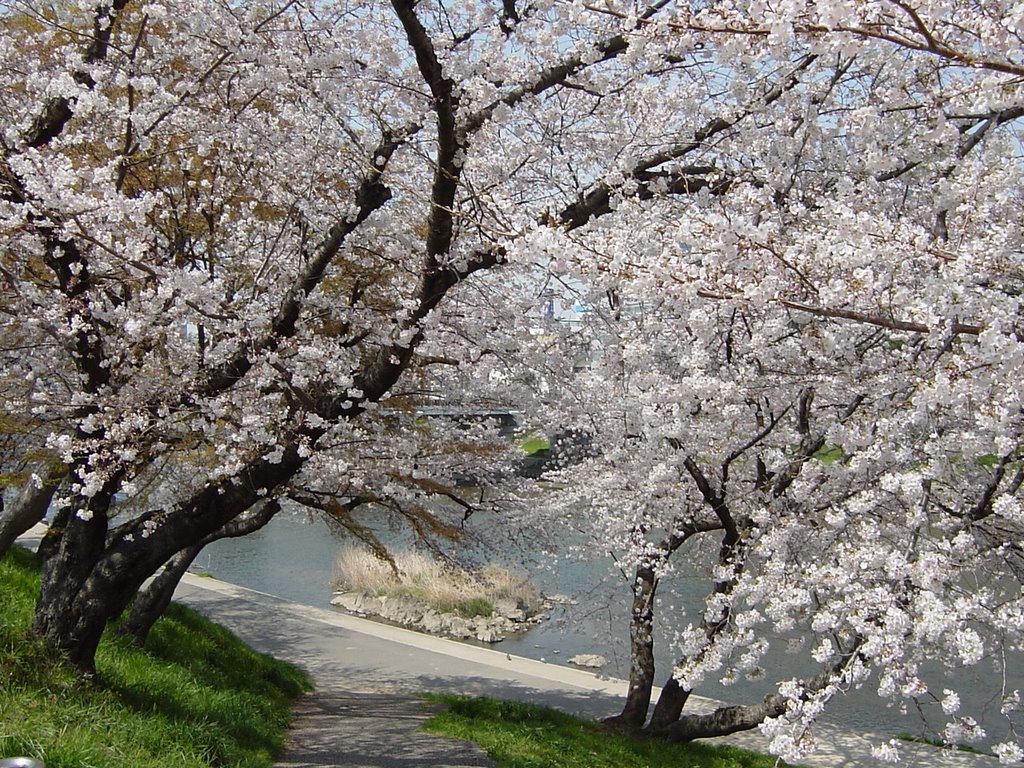
Somewhere between the cold Siberian winds of winter, and the Amazon jungle -like humidity of summer, comes a pleasant time called "Haru", which is the Japanese word for "Spring". Around the middle of March, amongst the commuting business men, tired students and the cast of neighborhood characters, there is a certain look in their faces. All are anticipating the arrival of the "Superstar of Spring". The celebrity of which I speak is not a movie star, or even a rock star. The celebrity of whom I speak is... The Japanese Cherry blossom, and the show is about to begin! From early March to the end of April, the cherry blossoms bloom, transforming the landscape of Japan into a fantasy world of pink and white flowers. People take time from their busy lives to go "cherry blossom viewing" called " Hanami". To enjoy "Hanami", you will need a few things: a plastic sheet to sit on, food and alcohol. If you happen to be a new employee of a company ,you may be chosen to stake out the best spot to view the show until the "groupies" come. In the evening, there is even a light show and food stands in case you get the munchies. The performance only last for two weeks, when the blossoms are dispersed by the wind and are replaced by green leaves. Admission is free. Rock and Roll!!
Saturday, March 04, 2006
Recycling Master

The land of "simple is best" philosophy, must have some of the most complicated recycling system in the the modern world. Requiring an advance degree in "Garbalogy" to understand. Garbage must be separated into no less then 14 categories of rubbish; Paper, Plastic bottles, Aluminum Cans, Glass Bottles, Harmful Garbage, Flammables, Burnable, Non-Burnable, Newspaper, Paper Cartons, Large garbage, Cardboard and Clothing. Being an armchair environmentalist , my wife and I have converted our spare room to a "Waste Management room", taking care to clean and rinse all items before placing then in specially produced recycling bags. The designated recycling area in our neighborhood is usually guarded by local senior citizens, who have taking an oath to protect and uphold the recycling rules. Each visit to the recycling area is usually accompanied by a lecture on "Rubbish 101" by one of the recycling masters. Having contemplated my past errors in meditation, I journeyed once more to the recycling area. The guards are waiting. " This is no good!" said one of the sentries in Japanese. " Cans with lids still attached, and cans without lids attached must be separated!". I apologized and returned home in shame.
Monday, February 20, 2006
A quick lesson in "Kanji" and an almost true story.
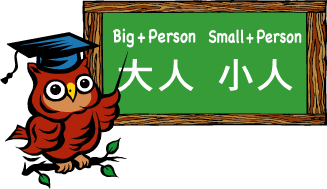
Before I tell you the story, lets have a quick lesson in "Kanji" first. Kanji are symbols that originate from China. Each symbol has a meaning. For example, the symbol for "Big" and the symbol for "Person" combined means "adult". The symbol for "small" and the symbol for "Person" combined means "child". Basic knowledge of "kanji" is essential for getting around Japan, as you will see in my story.
When I first visited Japan I had a basic knowledge of "Kanji" and could speak a little Japanese. I was visiting a friend in Tokyo, when I decided to venture out on my own in search of a "Sento". Which is the word for a public bath. When I found the public bath, I took my shoes off and entered. To my surprise, a elderly woman was sitting on a tall chair with a clear view of both the "Men's Locker Room" AND "Woman Locker Room"! Behind her was a sign in "Kanji". 300 Yen for "Adult" (big + person) and 100 Yen for "Child" (small + person). I paid her the 300 yen and reluctantly entered the locker room. As I was undressing, I noticed she was staring at me! I thought perhaps she doesn't see many naked Americans much. Suddenly, she gestured to me, indicating for me to come over to her. Have I done something wrong? As I approached her, she reached into the cash register and returned 200 Yen back!
Subscribe to:
Comments (Atom)